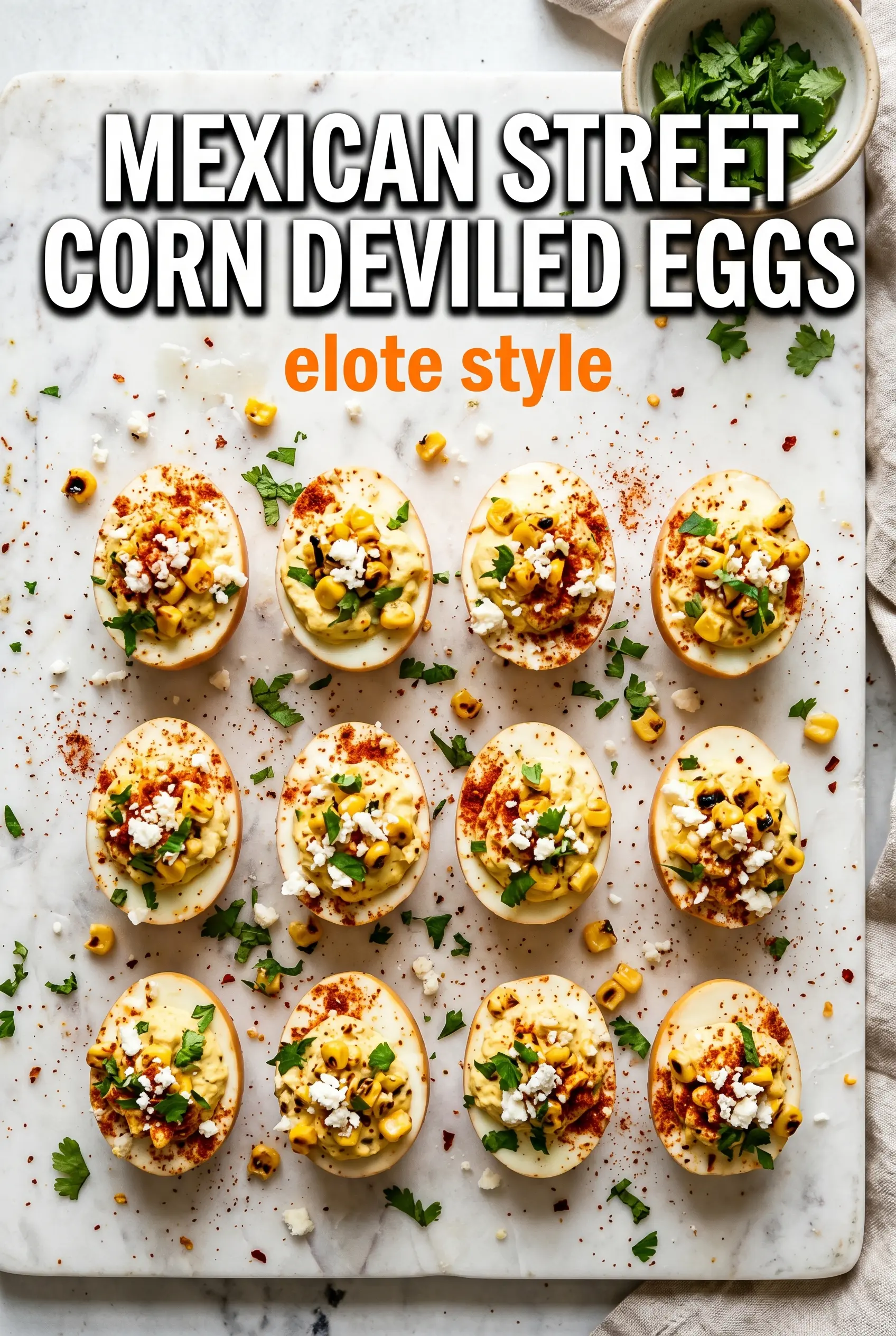
Mexican street corn deviled eggs hit that sweet spot between familiar and unexpected: creamy yolk filling, a bright lime tang, and the little pop of charred corn on top that keeps every bite interesting. They disappear fast because they taste like a deviled egg and an elote got together at the best possible party.
The filling stays smooth and balanced here because the mayo, lime juice, and Dijon are whisked into the yolks before anything else gets involved. That gives you a base that tastes rich without turning heavy, and the paprika adds warmth without muddying the color. The toppings matter just as much as the filling: lightly charred corn brings sweetness and texture, while cotija adds the salty finish that makes the whole thing taste like street corn instead of just decorated deviled eggs.
Below you’ll find the little timing detail that keeps the eggs easy to peel, plus the best way to char corn quickly without steaming it. There are also a few practical swaps if you want to adjust the heat, the cheese, or the make-ahead plan.
The yolk filling was silky and the lime really woke it up. I loved the charred corn on top because it kept the eggs from tasting one-note, and the cotija added just the right salty bite.
Save these Mexican Street Corn Deviled Eggs for a creamy, tangy appetizer with charred corn, cotija, and a little Cajun heat.
The Trick Is Keeping the Filling Bright, Not Heavy
Deviled eggs can go flat fast when the filling leans too far into richness and loses the sharp edge that makes people reach for a second one. Here, the lime juice and Dijon do more than add flavor — they keep the yolk mixture lively enough to stand up to the corn and cheese on top. If the filling tastes dull, it’s usually because the seasoning got added after the yolks were already mashed into a paste, which makes it harder to distribute evenly.
The other thing that matters is texture. A smooth filling pipes cleanly and gives you a polished base for the toppings, but it should still taste substantial, not airy. Mash the yolks first, then stir in the wet ingredients until the mixture turns creamy and glossy. That small order of operations keeps the filling from getting gummy.
- Yolks: Start with fully cooked eggs, but don’t overcook them until the yolks turn chalky or gray around the edges. That dry yolk makes the filling taste flat.
- Lime juice: Fresh lime juice is worth using here. Bottled will work in a pinch, but the flavor is sharper and less round.
- Dijon mustard: Dijon adds a little backbone and helps the filling emulsify. Yellow mustard will taste harsher and less balanced.
- Mayonnaise: Use a mayo you already like. Since it’s a major part of the filling, bland mayo shows up fast.
What Each Topping Is Actually Doing Here
These eggs work because the toppings aren’t just garnish. The charred corn brings the sweet, smoky note that makes the recipe feel like elote, and the cotija gives you that salty crumble that cuts through the richness of the yolk filling. Fresh cilantro and green onion keep the top from tasting heavy, and the Cajun seasoning adds a little heat and color without taking over.
If you can’t find cotija, feta is the best backup. It has a similar salty crumble, though it tastes a little tangier and less milky. For the corn, fresh kernels are excellent, but frozen corn works well if you dry it first and let it sit in a hot skillet long enough to brown instead of steam.
- Corn: Char it in a dry skillet over higher heat so the kernels blister and pick up color. If the pan is crowded, the corn steams and stays pale.
- Cotija: This is the ingredient that really makes the eggs read as street corn. Feta works, but it brings a stronger tang and a softer crumble.
- Cilantro and green onion: Use both if you can. Cilantro brings freshness, while green onion adds a mild bite that keeps the topping from tasting one-dimensional.
- Cajun seasoning: A light finish is enough. You want warmth and color, not a salty crust.
Building the Eggs So the Topping Stays Put
Cooking and Cooling the Eggs
Set the eggs into already boiling water and cook them for 10 to 12 minutes, depending on how firm you like the yolks. As soon as they come out, move them straight into an ice bath. That quick chill stops the cooking and makes peeling easier; if you skip it, the residual heat keeps setting the yolks and can leave you with dry, crumbly centers.
Making the Filling
Peel the eggs, halve them lengthwise, and scoop the yolks into a bowl. Mash the yolks before you add the mayo and lime juice, then whisk everything until it turns smooth and pipeable. If the mixture looks stiff, add another spoonful of mayo before you add anything else; once it gets too loose, there’s no clean fix.
Charring the Corn
Cook the corn kernels in a hot skillet for 2 to 3 minutes until the edges get browned and a few kernels blister. Keep them in a single layer and don’t stir constantly. You want contact with the pan, not movement, because that’s what gives you the smoky sweetness that makes these eggs taste like elote.
Finishing and Chilling
Pipe or spoon the filling into the egg whites, then top each one with corn, cotija, cilantro, green onion, and a light dusting of Cajun seasoning. Chill the eggs until serving so the filling firms up and the toppings settle into place. If you serve them too warm, the filling softens and the corn rolls off the top instead of staying where you put it.
How to Adapt These for Different Tables
Dairy-Free Version With the Same Elote Feel
Use a dairy-free mayo and skip the cotija, then finish with extra corn, cilantro, and a little more Cajun seasoning. You lose the salty crumble from the cheese, so add a tiny pinch more salt to the filling to keep the eggs from tasting flat.
Feta Instead of Cotija
Feta gives you a similar salty finish if cotija isn’t available. It crumbles a little softer and tastes tangier, so use a light hand or the topping can overpower the lime and corn.
Make It Milder for Kids or Heat-Sensitive Guests
Leave off the Cajun seasoning and use a very light hand with the paprika if you want a softer finish. The eggs still taste like street corn because the lime, corn, and cotija carry the flavor on their own.
Storage and Reheating
- Refrigerator: Store covered for up to 2 days. The topping stays best if you add the corn, cheese, and herbs close to serving.
- Freezer: Don’t freeze deviled eggs. The whites turn rubbery and the filling separates after thawing.
- Reheating: These are meant to be served cold or cool, not reheated. If they’ve been chilled hard, let them sit at room temperature for 10 to 15 minutes so the filling tastes creamy again.
Answers to the Questions Worth Asking
Mexican Street Corn Deviled Eggs (Elote-Style)
Ingredients
Equipment
Method
- Add eggs to a pot and cover with water, bringing it to a boil; boil for 10-12 minutes. Visual cue: the yolks should look set all the way through.
- Transfer eggs to an ice bath and cool until chilled, about 5 minutes. Visual cue: the shells should feel cold to the touch.
- Peel eggs and cut them in half lengthwise, then place the halves on a sheet pan. Visual cue: you should see a clean, centered yolk in each egg.
- Scoop the yolks into a bowl and mix with mayonnaise, lime juice, Dijon mustard, paprika, salt, and pepper until smooth. Visual cue: the mixture should be thick and uniform with no visible yolk streaks.
- Pipe or spoon the filling into the egg white halves. Visual cue: each egg white half should be generously and evenly filled.
- Heat a hot cast iron skillet and char corn kernels for 2-3 minutes. Visual cue: kernels should develop browned, blistered spots but not burn.
- Spoon charred corn onto each deviled egg. Visual cue: corn sits in a visible mound over the filling.
- Top with cotija cheese, cilantro, and green onions. Visual cue: the topping should look speckled and golden from the corn.
- Finish with a sprinkle of Cajun seasoning. Visual cue: you should see a light dusting across the top.
- Refrigerate until ready to serve, about 5 minutes to set the filling. Visual cue: the topping will look slightly firmer and the flavors will meld.